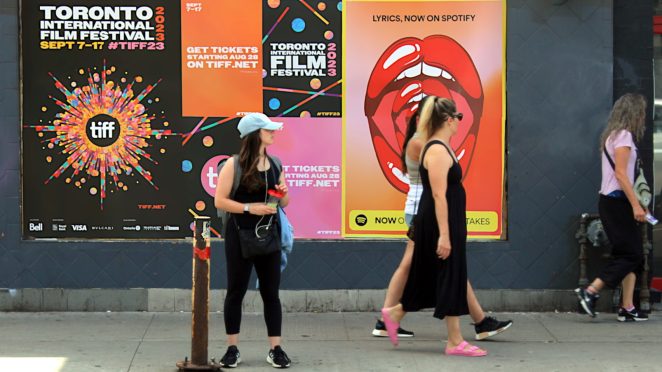
Experiential street marketing turns an ordinary moment into something people can see, touch, join, photograph, taste, or discuss. At Grassroots Advertising, that is how we approach experiential street marketing: use the street as more than media space and turn the right place, timing, creative idea, and human interaction into a memorable brand moment.
After more than 40 years at street level, we have learned that the best activations never feel random. A projection changes a familiar building after dark. A street team brings a product directly to the people most likely to use it. A display truck becomes a moving experience.
That is the difference between occupying public space and designing a campaign around how people actually move through it.
What Is Experiential Street Marketing?
Experiential street marketing uses public or high-traffic urban spaces to create direct, real-world interactions between a brand and its audience. It can include sampling, street teams, interactive projections, mobile displays, custom installations, games, demonstrations, or several tactics working together.
The important word is “experiential.” Visibility alone is not the goal.
A strong execution gives someone a role. They might try a product, trigger a projection, take a photo, play a game, carry away a branded object, or discover something unexpected enough to share.
We have delivered experiential marketing campaigns across Canada and the United States. The format changes from brief to brief, but the physical idea always needs to connect to a clear audience action.
Why Do Public Spaces Work So Well for Brand Activation?
Public spaces work for brand activation because the audience is already there, moving through a real routine. The campaign does not need to manufacture context.
A nightlife activation can meet people when they are already social. Sampling near a campus can reach students during their normal day. A mobile display near an arena can connect with fans around an event. A projection can use darkness, architecture, and pedestrian traffic to turn a building into part of the idea.
From our experience, location should answer three questions:
- Who is here? The audience should match the people the brand wants to reach.
- Why are they here? Their mindset matters as much as foot traffic.
- What can they realistically do? The interaction has to fit the space and pace.
High traffic is useful. Relevant traffic is better.
The Best Street Marketing Campaigns Give People Something to Do
The strongest street marketing campaigns turn passersby into participants. Often, the simplest action is the most effective.
For ScotiaGallery, people could use a hashtag and see their Instagram photos livestreamed onto city projections. During the NBA Finals, a Tangerine campaign projected live Raptors scores across Toronto. For Malibu Rum, we transformed a display truck into a mobile tropical bar environment with beach-inspired details and a photo wall.
Each execution used the city differently, but all made the environment part of the idea.
That participation creates a story someone can retell. “I saw an ad” is forgettable. “My photo appeared on a building” is a moment.
Street Team Marketing Adds the Human Layer
Street team marketing works when a campaign benefits from conversation, sampling, demonstrations, or feedback. A trained ambassador can turn curiosity into interaction.
Our street team marketing programs support product sampling, human billboard campaigns, costumes, demonstrations, and other street-level executions.
Staffing cannot be an afterthought. The team needs to understand the brand, offer, audience, and expected interaction. They need a clear plan for where to stand, how to approach people, what to say, what to distribute, and when to move.
The best ambassadors do not sound like scripts walking down the sidewalk. They make the brand feel approachable.
Experiential Advertising Needs the Right Format for the Idea
Experiential advertising becomes more effective when the medium supports the idea. We do not force every brief into the same execution.
A product that needs trial may benefit from sampling. A launch needing spectacle may call for projections. A campaign moving between neighborhoods may work better with a mobile display. A participation-led concept might need a game, custom fabrication, or street team.
| Campaign goal | Street-level format to consider |
|---|---|
| Product trial | Sampling and demonstrations |
| Nighttime spectacle | Projection advertising |
| Face-to-face engagement | Street teams |
| Mobile reach | Display or billboard trucks |
| Photo and social content | Interactive installations |
| Physical brand immersion | Custom fabrication |
Our job is to find the physical format that makes the marketing idea easier to understand, not just bigger.
Interactive Marketing Has to Make Sense in Seconds
Interactive marketing in public space has a short window to make sense. People are walking to work, meeting friends, leaving an event, catching transit, or moving between errands. If an activation needs a long explanation before anyone understands what to do, the idea is working against the environment.
We like interactions with a visible invitation and a quick payoff.
Push this. Try this. Taste this. Stand here. Scan this. Take one. Play.
Our projection advertising can combine large-scale visuals with gaming, green screens, social elements, live streaming, SMS triggers, or other interactive components. The technology earns its place when the audience can understand how to enter the experience.
Outdoor Experiential Marketing Must Work in Real Conditions
Outdoor experiential marketing has to survive real streets. There are crowds, weather, traffic patterns, noise, changing light, municipal requirements, competing visual clutter, and people who may use an installation differently than a presentation deck predicts.
That is why execution planning matters as much as the concept.
Before launch, we ask practical questions:
- Can people see the activation from their approach?
- Is there enough room for them to stop safely?
- Does it still work during the busiest period?
- What happens if weather changes?
- Does staffing change by time of day?
- Are permits, insurance, or location approvals required?
- How will materials, equipment, samples, and staff reach the site?
A great street idea still needs a street plan.
Time and Place Are Part of the Creative
Experiential marketing campaigns become stronger when timing and location work together. We look at where the audience will be, what will be happening around them, and which message makes sense in that moment.
An entertainment launch can build around a concert crowd. A beverage brand can focus on social environments. A retailer can create a reason to visit a nearby store. A cultural campaign can connect with a neighborhood event.
We have learned not to treat “downtown” or “high traffic” as a strategy by themselves.
The better question is: where does this idea become more meaningful?
That might be one high-density block, several neighborhoods, an event perimeter, a campus, nightlife district, or a route connecting audience pockets.
The street is not one audience. Every block has context.
How Do You Measure an Experiential Brand Activation?
An experiential brand activation should be measured against the action it was designed to create. Impressions may matter for visibility, but they are not the only useful result.
Depending on the objective, we may plan around:
- Samples distributed
- Direct interactions
- QR scans
- Sign-ups or redemptions
- Product demonstrations
- Social posts or user-generated content
- Foot traffic
- Campaign photos
- Geographic coverage
- Qualitative street-team feedback
Measurement works best when decided before execution.
If the goal is trial, distribution and engagement matter. If the goal is content, the installation has to photograph well. If the goal is store traffic, location and the call to action need to make that next step realistic.
What Four Decades of Street-Level Campaigns Have Taught Us
After thousands of campaigns, our biggest lesson is that experiential street marketing is not about making public spaces louder. It is about making the brand more relevant to what is already happening there.
We have transformed trucks into mobile environments, projected interactive creative onto buildings, put ambassadors into high-traffic neighborhoods, supported sampling programs, and executed unusual ideas that did not fit traditional media boxes. Our award-winning campaign work includes projects for IKEA, Doritos, P!NK, Tangerine, Malibu Rum, and other brands.
Across those executions, the fundamentals stay consistent:
- Know exactly who you want to reach.
- Choose a place that adds meaning.
- Give people an obvious way to participate.
- Make the experience worth remembering.
- Plan logistics as carefully as creative.
- Build an idea that can travel beyond the street.
That is how public space becomes a brand moment instead of another advertising placement.
Bring Your Next Brand Moment to the Street With Grassroots Advertising
At Grassroots Advertising, we have spent more than 40 years learning what makes street-level campaigns work: where people stop, what creates curiosity, and how neighborhoods change an execution.
We offer street teams, sampling, experiential concepts, projections, mobile vehicle advertising, custom executions, and integrated guerrilla marketing across major markets in Canada, the United States, and Europe.
If you have an idea that needs to live outside a screen, we can help determine the right format, location, timing, staffing, production, and street-level logistics to bring it to life.
The goal is not simply to put a brand in public space.
It is to give people a reason to remember what happened there.